

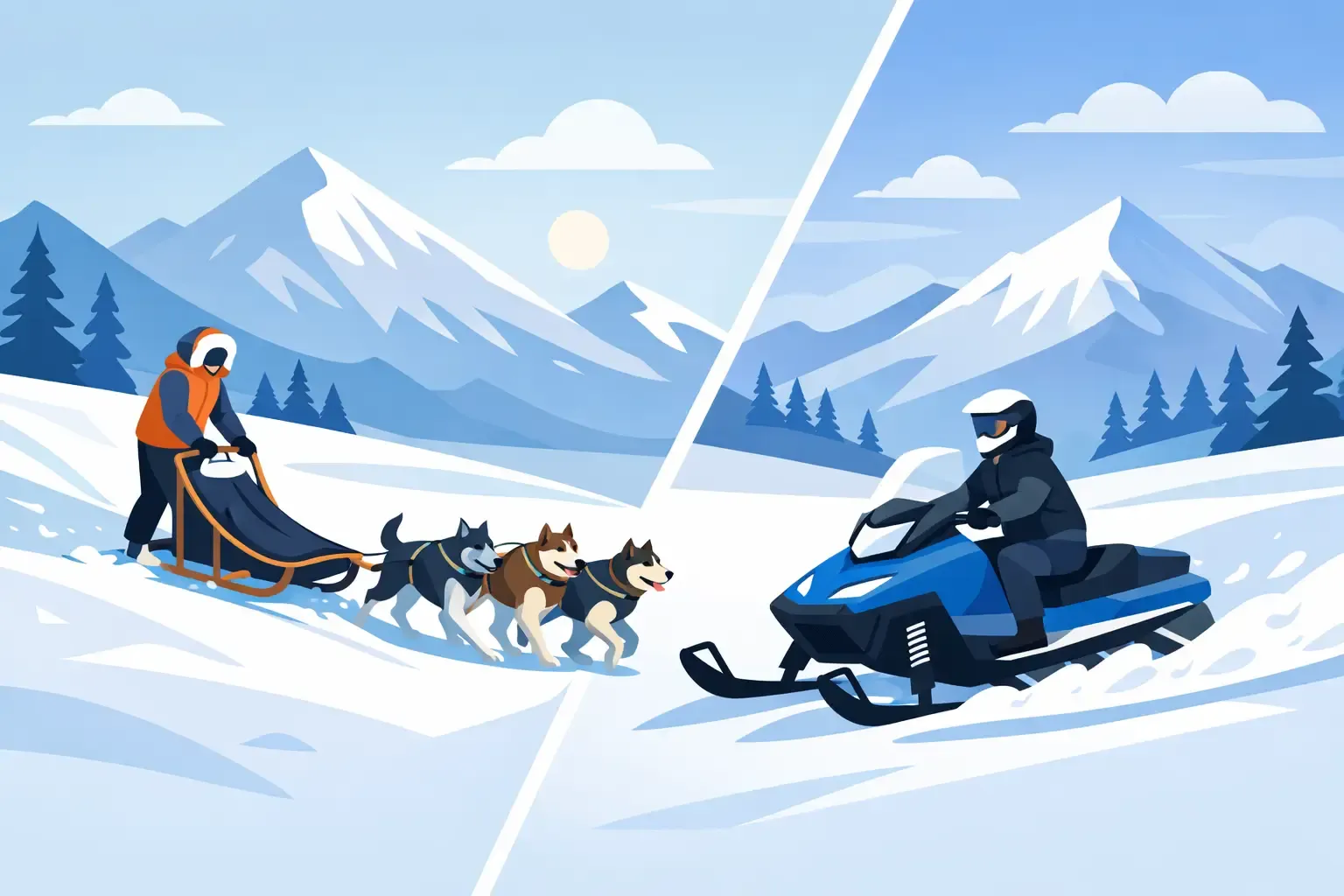
Dog Sledding or Snowmobiling: Which Is for You?
The decision between dog sledding or snowmobiling is not really about choosing a faster way through the snow. It is about deciding how you want to meet the Arctic. One puts you behind a team of powerful huskies, travelling at their rhythm through silent forest. The other gives you the throttle, the range and the exhilaration of covering vast frozen landscapes under your own control.
Both can be unforgettable. Both can take complete beginners into terrain that would otherwise feel far beyond reach. But they create very different kinds of stories to bring home.
Dog sledding or snowmobiling: the essential difference
Dog sledding is close, physical and connected. You work with a husky team, learn how to handle the sled and feel the trail through your feet and hands. The soundscape is remarkable: runners whispering over snow, paws striking the track, the occasional command from your guide and, often, very little else. It is a brilliant choice for travellers who want an Arctic experience that feels rooted in the landscape and its traditions.
Snowmobiling is more dynamic. You travel further, climb gentle rises, cross frozen lakes and follow trails through forests at a pace that makes the wilderness feel properly expansive. There is real excitement in learning to steer a machine across snow, especially when the light is low and the evening sky begins to sharpen around you.
Neither is the ‘better’ adventure. The right choice depends on whether you are seeking connection or speed, quiet immersion or high-energy exploration – and whether you want to be passenger, driver or active team member.
Choose dog sledding for a deeper connection to the trail
A husky sled journey is often the moment people remember most clearly from an Arctic week. Before you set off, the dogs are full of anticipation. They bark, leap and strain towards the trail. Then the sleds begin moving and the noise falls away almost at once. It can feel as if someone has turned down the whole world.
You are not simply being taken for a ride. On a guided trip, you will usually be shown how to brake, help the dogs on hills, keep a safe distance from the sled ahead and work with your team. It is accessible to beginners, but it asks you to participate. That is part of its appeal.
Dog sledding suits travellers who enjoy wildlife, traditional skills and a more elemental pace. It is especially good for couples, solo travellers and small groups who want to share something unusual without needing previous technical experience. The physical effort is manageable for most reasonably active people, though standing on a sled in cold conditions can be more tiring than it looks.
What dog sledding feels like
Expect a mix of calm and concentration. You will need to stay alert to the trail and listen to your guide, but there are long stretches when your only job is to look around and take it in. Snow-laden spruce, a pale winter sun and a line of ears running ahead of you can make even a short journey feel far from ordinary life.
The trade-off is that your route and pace are led by the dogs, trail conditions and welfare needs of the team. That is exactly as it should be. You may not cover the same distance as you would by snowmobile, but what you gain is a slower, more intimate experience of the landscape.
Choose snowmobiling for range and adrenaline
Snowmobiling gives you a sense of freedom that is hard to match. After a careful briefing and a chance to get comfortable with the controls, you can head out into a landscape that seems to stretch without end. A well-planned route may carry you across open lakes, through dense woodland and towards viewpoints that would take much longer to reach on foot or by sled.
For many first-timers, the surprise is how quickly confidence grows. You do not need motorsport experience. You do need to listen closely, ride within your limits and respect the spacing and signals set by your guide. A guided snowmobile journey is not a race. It is a proper wilderness outing, where safety, conditions and group awareness come before speed.
Snowmobiling is often ideal for friendship groups, active couples and anyone who wants a big hit of adventure in a limited amount of time. It can also be a strong choice if your dream is to travel through a wide Arctic landscape, perhaps stopping to make a fire, drink something warm or scan the horizon for wildlife.
What snowmobiling feels like
The first pull of the throttle brings a jolt of excitement. Cold air finds any gap in your clothing, the trail rushes beneath you and the forest opens and closes around each bend. On a clear evening, it can feel like travelling through another planet.
The trade-off is noise and exposure. Modern snowmobiles are capable machines, but they are still machines. You will hear the engine, feel vibration and need to dress properly for wind chill. If your ideal winter memory is complete silence, dog sledding will usually be the stronger fit. If you want to cover ground and feel the buzz of driving, snowmobiling has the edge.
Consider the practical details before you decide
Cold affects every Arctic activity, so quality clothing matters whichever route you choose. Guided operators normally provide or advise on specialist outer layers, boots and helmets where needed, but bring warm base layers, good socks and gloves you can manage comfortably. Fingers and toes deserve attention before photographs do.
Snowmobiling generally requires more focus on driving rules, insurance arrangements and, depending on the destination, licence requirements. Check these before booking rather than assuming a standard UK driving licence covers every situation. If you share a snowmobile, take turns driving and riding as passenger, which can be a good option for anyone unsure about handling a machine for a full day.
Dog sledding has its own practical considerations. You may spend extended periods standing, and you will need to follow instructions around the dogs with care. Reputable experiences put animal welfare first, use trained teams and explain how guests should behave around the animals. Ask questions if this matters to you – it should.
For either activity, the best trips are led by people who know the terrain, weather and local conditions. Arctic travel rewards good judgement. A route that looks simple on a map can change quickly with snowfall, wind, visibility or temperature.
Why not build an Arctic trip around both?
For many people, the best answer to dog sledding or snowmobiling is not one or the other. It is both, on different days and for different reasons. Start with snowmobiling to understand the scale of the terrain. Follow it with dog sledding when you are ready to slow down and feel closer to it.
The contrast makes the whole journey richer. One day, you are steering through a white corridor of trees with the engine humming beneath you. The next, you are standing behind a husky team as the forest returns to silence. Neither experience cancels out the other. Together, they show two sides of winter travel: the thrill of moving fast and the privilege of travelling lightly.
Snow and Paddles designs guided Arctic adventures for people who want that balance of challenge, care and proper wilderness time. Whether you are new to snow travel or looking for a bigger expedition, expert support lets you focus on the experience rather than the logistics.
Make your choice based on the memory you want
Choose dog sledding if you want stillness, teamwork with animals and a journey shaped by the trail rather than the clock. Choose snowmobiling if you want to drive, travel farther and feel the immediate rush of Arctic speed. Choose both if you have the time, because the most memorable adventures rarely ask you to stay in one lane.
Whatever you decide, arrive ready to be outside, to learn something new and to let the cold sharpen your senses. The Arctic does not need much from you – just curiosity, good layers and the willingness to go.