

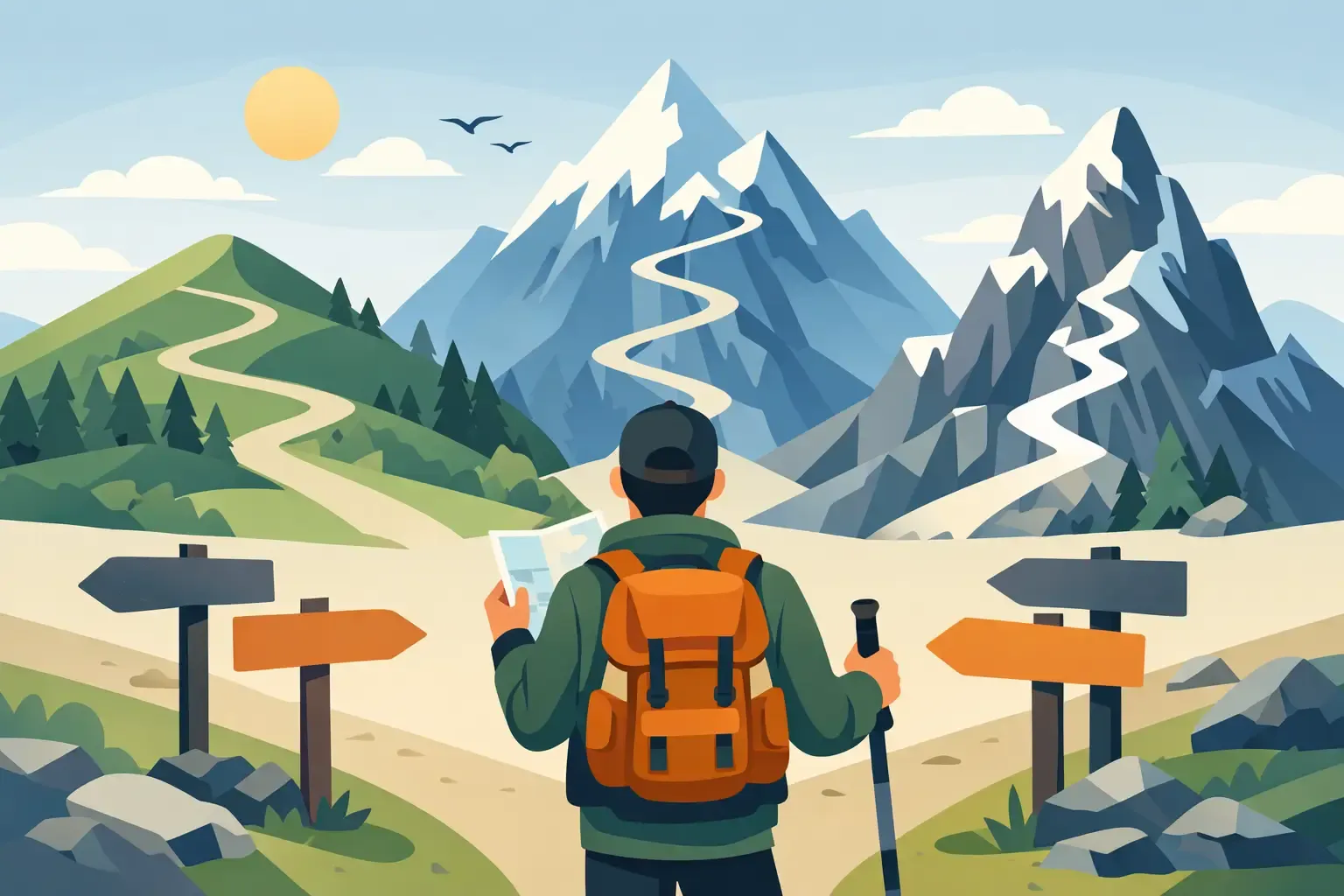
How to Pick Expedition Difficulty
You do not need to choose the hardest expedition for it to change you.
That is the first thing to remember when working out how to pick expedition difficulty. The right trip should stretch you, not flatten you. It should leave you tired, proud and sharper than when you started, not simply relieved that it is over. Whether you are looking at a canoe journey, a winter trip in Sweden or a high-altitude challenge, the best choice is the one that matches your current ability, your mindset and what you actually want from the experience.
Too many people get this wrong in both directions. Some book below their level and come home feeling underused. Others chase a bucket-list challenge before they are ready and spend the whole trip surviving rather than absorbing it. A good expedition sits in the middle. It asks something of you, but it also gives plenty back.
What expedition difficulty really means
Difficulty is not just about distance or how steep a hill is. It is a combination of physical effort, technical skill, terrain, weather exposure, remoteness, comfort levels and the consequences of mistakes.
A two-day canoe trip can feel tougher than a longer trekking journey if you are battling wind, carrying kit and working on unfamiliar skills all day. A snow expedition might not involve huge mileage, but cold management, layered clothing and moving confidently in winter conditions add another level. Altitude changes things again. So does sleep, or lack of it.
That is why how to pick expedition difficulty starts with understanding what will actually make the trip hard for you. Your challenge might be fitness. It might be confidence. It might be the idea of being in a remote landscape with limited phone signal and no café at the end of the trail.
Start with your real baseline, not your optimistic one
Most people know their best-day version of themselves. Fewer know their expedition version.
An expedition day is rarely a fresh Saturday morning with a good breakfast behind you and a warm shower ahead. It is day three, your legs are heavy, the weather has turned, your hands are cold and you still need to move well, make decisions and look after your kit. That is the standard you should measure against.
Be honest about your current fitness. Can you walk for several hours on uneven ground? Paddle steadily for a full day? Carry a pack without your shoulders giving up? If you already train outdoors, you have useful reference points. If you do not, that does not rule you out. It simply means you should choose an expedition that is designed to welcome beginners and build them up.
There is no glory in pretending. Good choices are made from your real starting point.
How to pick expedition difficulty for your goals
Not every adventure traveller wants the same thing, even if they are booking the same kind of trip.
Some people want a confidence-building first step into the outdoors. Some want space, silence and proper immersion in wild places. Others want a serious test that demands commitment before they even leave home. If your goal is to reconnect, reset or learn new skills, a moderate expedition may deliver far more than an extreme one. If your goal is a long-held physical challenge, you may need something tougher, but only if the foundation is there.
Ask yourself a simple question: do you want this trip to introduce you, develop you or test you?
If it is an introduction, choose guided support, manageable daily effort and a learning-friendly environment. If it is development, look for longer days, more self-sufficiency and conditions that push your judgement. If it is a test, make sure you are not mistaking ambition for readiness.
Fitness matters, but skill and mindset matter too
A common mistake is to treat expedition difficulty as a fitness-only decision. Fitness matters, of course. It makes long days more enjoyable and gives you a bigger margin when conditions become demanding. But it is only part of the picture.
Skill can reduce effort. A paddler with efficient technique will often finish the day in better shape than a stronger beginner forcing every stroke. The same goes for foot placement on rough ground, campcraft in poor weather or using winter kit properly.
Mindset matters just as much. Can you stay calm when plans change? Can you keep going when you are wet, cold or tired? Are you open to coaching? Guided expeditions are there to support you, but they work best when you bring resilience and a willingness to adapt.
If you are physically capable but inexperienced, a well-led trip with progression built in can be the right choice. If you are fit but resistant to discomfort, a very remote or exposed expedition may feel harder than expected.
Look closely at the type of hardship
Not all difficulty feels the same. One person is comfortable with big physical days but hates cold. Another is happy in winter but struggles with heights. Someone else can cope with discomfort but finds remote environments mentally draining.
When comparing trips, look beyond labels such as beginner, intermediate or challenging. Ask what the hardship actually is. Is it endurance? Technical movement? Repeated early starts? Carrying equipment? Cold exposure? Basic camp life? Altitude? Water confidence?
This matters because the right expedition is not always the easiest one. It is the one whose demands suit the kind of challenge you are ready to meet.
Guided support changes the equation
One of the biggest advantages of a properly guided expedition is that it can make demanding environments more accessible without pretending they are easy.
Experienced leaders manage route choices, weather decisions, safety systems, pacing and group care. They help you learn faster and avoid common mistakes. That support can open the door to landscapes and experiences that would feel out of reach if you were organising everything yourself.
But guided does not mean effortless. You still need to contribute, prepare and turn up ready to engage. Think of leadership as a safety net and a springboard, not a shortcut.
This is often where first-time expedition travellers find their sweet spot. With the right team around them, they can choose something more ambitious than they would sensibly attempt alone, while still staying within a realistic difficulty range.
Match the trip to the time you have to prepare
A harder expedition is not only about what happens on the ground. It is also about what it asks of you beforehand.
If you have three months and a busy working life, there is a limit to how much training, kit testing and logistical planning you can do well. That does not mean you should not go. It means you should choose an expedition that fits your preparation window.
This is especially true for altitude, winter journeys and longer remote trips. They tend to reward preparation and expose shortcuts. A shorter expedition or a UK-based adventure can be a brilliant move if it helps you build experience, confidence and useful habits for something bigger later.
There is real value in progression. Strong expedition travellers are usually built, not born.
A word on ego, groups and social pressure
If you are booking with friends or a partner, be careful. Group energy can push people into the wrong decision.
Nobody wants to be the person who says, “That might be too much for me.” But saying yes to the wrong level is far more frustrating than choosing a challenge that you can genuinely enjoy and grow through. On a good expedition, the group should be stretched together, not split between those cruising and those hanging on.
If abilities are mixed, it is often better to choose the trip that suits the least experienced person and let the stronger members enjoy moving well, helping out and soaking up more of the experience. Adventure is not diminished because you are capable within it.
The best choice usually feels exciting with a hint of nerves
There is a useful test when deciding how to pick expedition difficulty. The right trip usually brings a clear sense of excitement and a manageable amount of uncertainty. You should feel respect for it, maybe even butterflies, but not a steady knot of dread.
That feeling matters because expeditions are meant to expand your world. If the challenge is too low, there is less growth. If it is too high, your energy gets swallowed by coping. Somewhere in the middle is the ground where confidence is built.
For many people, that means choosing the trip that feels like the next step, not the final form. A well-chosen canoe expedition, winter journey or wilderness experience can be the one that sets up the bigger dream later on. That is how lasting adventure often works.
If you are unsure, ask questions, be honest and choose the challenge that gives you room to rise. At Snow and Paddles, that is where the best expeditions begin.